
Cycloidal Path Model
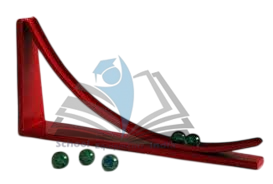
Product Code : SCL-EE-12158
The Cycloidal Path Model by School Equipments India is an educational demonstration model designed to explain the formation of a cycloid curve, rolling motion, geometry of curves, periodic path tracing, and practical applications of mathematical curves. It is widely used in school mathematics laboratories, physics classrooms, STEM labs, activity rooms, and science exhibitions to help students understand how a point on the circumference of a rolling circle traces a cycloidal path.
This model provides a visual and hands-on method to demonstrate the relationship between circular motion and linear motion. When a circular disc or wheel rolls along a straight surface, a marked point on its edge forms a curved path known as a cycloid. The model is suitable for teaching coordinate geometry, curves, motion, rotation, translation, and applied mathematics in a classroom-friendly way.
A Cycloidal Path Model is a practical teaching aid used to demonstrate how a cycloid is generated. The model generally consists of a rolling wheel or circular disc, track or base board, marking point, tracing arrangement, and support components as per the supplied design. When the wheel rolls without slipping on a straight path, the point fixed on its circumference traces a smooth arch-like curve.
This model helps students observe that a cycloid is not a simple circle or wave, but a special curve formed by the combined effect of rotation and forward movement. It is useful for explaining important mathematical and physical concepts such as rolling motion, locus of a point, parametric curves, periodic curves, and motion along a path.
The School Equipments India Cycloidal Path Model is suitable for classroom demonstrations, mathematics lab activities, physics practical learning, STEM projects, and exhibition displays. It helps teachers convert abstract curve concepts into visible and understandable demonstrations.
The Cycloidal Path Model is an important teaching aid because it helps students understand the formation of mathematical curves through direct observation. Instead of only studying curve equations or diagrams, students can see how a cycloid is created by the movement of a rolling circle.
Teachers can use this model to explain the concept of locus, curve tracing, rotation, translation, rolling motion, and parametric representation of curves. It also helps connect mathematics with physics and engineering applications, improving students’ practical understanding and analytical thinking.
The Cycloidal Path Model is a useful educational model for schools looking for mathematics lab models, physics motion models, STEM teaching aids, and practical curve demonstration equipment. It helps students understand cycloid formation, rolling motion, locus of a point, rotation, translation, geometry of curves, and applied mathematics through hands-on observation.
School Equipments India supplies educational science models, mathematics lab models, physics apparatus, STEM kits, laboratory equipment, geography models, and classroom teaching aids for schools and institutions. The Cycloidal Path Model is designed for practical classroom use and supports clear explanation of curve formation, rolling motion, and geometry concepts.
This product content supports Google E-E-A-T guidelines by providing clear product information, accurate educational purpose, practical usage instructions, product specifications, safety guidance, and classroom applications. The content is written for mathematics teachers, science teachers, school buyers, STEM educators, laboratory planners, and educational institutions looking for dependable teaching models.
Cycloidal Path Model, cycloid model for school, cycloidal curve model, mathematics lab model, rolling motion model, locus of a point model, physics motion demonstration model, STEM mathematics teaching aid, curve tracing model, School Equipments India Cycloidal Path Model.
A Cycloidal Path Model is an educational teaching model used to demonstrate how a point on the circumference of a rolling circle traces a cycloid curve.
It is used to teach students about cycloid curves, rolling motion, locus of a point, rotation, translation, and geometry of curves.
It demonstrates that when a circle rolls along a straight line without slipping, a fixed point on the circle traces a cycloidal path.
No, the Cycloidal Path Model is a manual educational demonstration model and does not require electricity.
This model is useful for mathematics, physics, STEM education, engineering basics, geometry, and motion studies.
Yes, students can operate the model under teacher supervision. It is designed for hands-on learning and classroom demonstration.
Students can learn how circular motion and linear motion combine to form a cycloid, along with concepts of rolling motion, curve tracing, and locus.
Yes, it is useful for science exhibitions and mathematics project displays because it provides a clear visual demonstration of curve formation.
The model should be handled carefully, cleaned with a soft cloth, and stored in a clean, dry, and safe place after use.
This Cycloidal Path Model is supplied by School Equipments India.
Cycloidal Path Model for School Mathematics and Physics Laboratory
Product Description
Key Features
Product Specifications
Product Name
Cycloidal Path Model
Brand
School Equipments India
Category
Mathematics Lab Model / Physics Motion Model / STEM Teaching Aid
Application
Demonstration of cycloid curve formation, rolling motion, and locus of a point
Working Principle
A point on the circumference of a rolling circle traces a cycloidal path when the circle rolls without slipping
Main Components
Rolling disc or wheel, base track, marked tracing point, support frame, guide arrangement, and accessories as per supplied model
Suitable For
Schools, colleges, mathematics laboratories, physics laboratories, STEM labs, activity rooms, and science exhibitions
Usage Type
Manual educational demonstration and practical learning model
Learning Topics
Cycloid, rolling motion, geometry of curves, locus, rotation, translation, periodic motion, and applied mathematics
Power Requirement
No electricity required
Material
Durable educational-grade materials; specifications may vary as per supplied model
Packaging
Securely packed for safe transportation and institutional supply
How to Use the Cycloidal Path Model
Safety and Handling Instructions
Educational Importance
Applications
SEO-Friendly Product Benefits
Why Choose School Equipments India?
E-E-A-T Content Note
SEO Keywords
Frequently Asked Questions
1. What is a Cycloidal Path Model?
2. What is the use of this model in schools?
3. Which principle does the Cycloidal Path Model demonstrate?
4. Does this model require electricity?
5. Which subjects can use the Cycloidal Path Model?
6. Can students operate this model?
7. What can students learn from this model?
8. Is the Cycloidal Path Model useful for science exhibitions?
9. How should the model be maintained?
10. Which brand supplies this Cycloidal Path Model?
 (1).png)

 (1)-Photoroom.png)
 (1).png)

.jpg)

.png)