Kinetic Theory Model Manufacturer,Supplier and Exporter in India
Product Code : SCL-EE-12160
The Kinetic Theory Model by School Equipments India is an educational physics demonstration model designed to explain the kinetic theory of matter, molecular motion, gas pressure, particle collision, temperature effect, and the behavior of particles in solids, liquids, and gases. It is widely used in school physics laboratories, science classrooms, STEM labs, and science exhibitions to help students understand how microscopic particle motion affects visible physical properties.
This model provides a practical and visual way to demonstrate that particles of matter are always in motion. It helps students observe how increased energy or vibration causes particles to move faster, collide more frequently, and spread apart. The model is suitable for teaching gas laws, molecular motion, Brownian motion, pressure, temperature, diffusion, and states of matter.
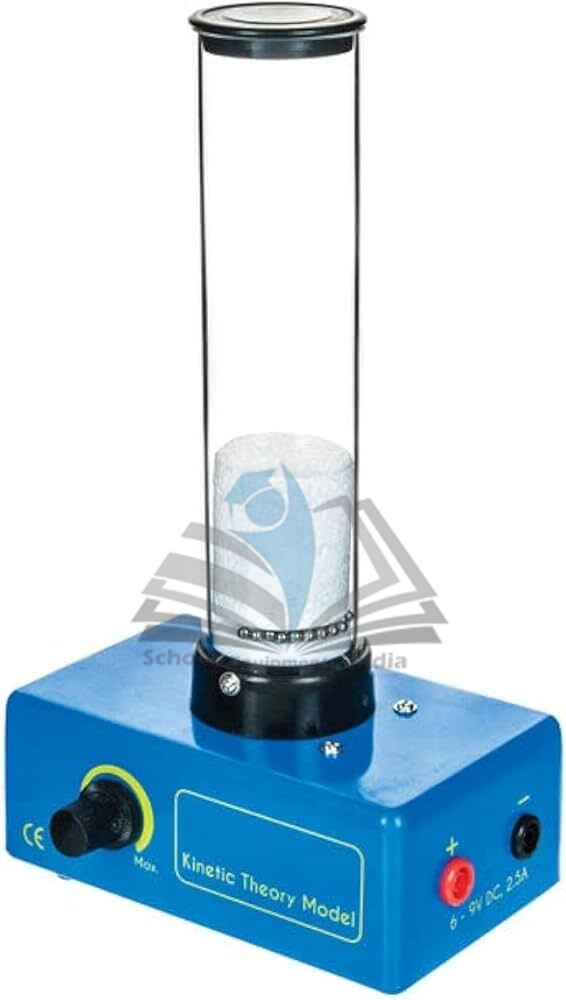
The Kinetic Theory Model is a classroom-friendly teaching aid used to demonstrate the movement of particles in matter. The model generally consists of a transparent chamber, small beads or particles, vibration mechanism, base unit, control arrangement, and observation window as per the supplied design. When the model is operated, the particles inside the chamber move randomly, representing the motion of gas molecules.
Students can observe that particles move in all directions and collide with each other and with the walls of the container. These collisions help explain gas pressure. When the vibration or input energy is increased, the particles move faster, helping students understand the relationship between temperature and molecular kinetic energy.
The School Equipments India Kinetic Theory Model is suitable for physics practicals, classroom demonstrations, STEM learning, science exhibitions, and activity-based teaching. It helps convert an abstract molecular-level concept into a visible and easy-to-understand demonstration.
The Kinetic Theory Model is an important teaching aid because it helps students visualize particle motion that cannot be seen directly in real gases. It makes abstract ideas such as molecular motion, kinetic energy, pressure, and temperature easier to understand through observation.
Teachers can use this model to explain why gases exert pressure, why particles move faster at higher temperature, how diffusion occurs, and how matter behaves at the particle level. It supports practical learning, scientific thinking, observation skills, and classroom discussion.
The Kinetic Theory Model is a reliable physics lab model for schools looking for practical molecular motion and kinetic theory demonstration equipment. It helps students understand kinetic theory, gas molecules, random motion, particle collision, temperature effect, gas pressure, diffusion, and states of matter through hands-on classroom observation. This model is suitable for science teachers, school laboratories, STEM programs, educational institutions, and science fair demonstrations.
School Equipments India supplies educational science models, physics laboratory apparatus, STEM kits, laboratory equipment, chemistry models, biology models, geography models, and classroom teaching aids for schools and institutions. The Kinetic Theory Model is designed for practical classroom use and supports clear explanation of molecular motion and particle behavior.
This product content supports Google E-E-A-T guidelines by providing clear product information, accurate educational purpose, practical usage instructions, product specifications, safety guidance, and relevant classroom applications. The content is written for science teachers, school buyers, STEM educators, laboratory planners, and educational institutions looking for dependable physics demonstration models.
Kinetic Theory Model, kinetic theory model for school lab, molecular motion model, kinetic theory of gases apparatus, gas molecule demonstration model, particle motion model, physics lab kinetic theory model, Brownian motion teaching model, STEM physics teaching aid, School Equipments India Kinetic Theory Model.
A Kinetic Theory Model is a physics demonstration model used to show the random motion of particles and explain the kinetic theory of matter or gases.
It is used to teach students about molecular motion, particle collision, gas pressure, temperature effect, diffusion, and kinetic energy.
It demonstrates that particles of matter are in constant random motion and that their kinetic energy increases when temperature or energy input increases.
Some models may require a battery or suitable low-voltage power supply to operate the vibration mechanism. The requirement may vary as per the supplied model design.
The moving particles represent molecules of a gas moving randomly and colliding with each other and with the walls of the container.
The model shows that gas pressure is produced when moving particles collide with the walls of a container.
Yes, it is suitable for school physics laboratories, science classrooms, STEM labs, colleges, and practical demonstrations.
Yes, students can observe and operate the model under teacher supervision. Proper care should be taken while using electrical or moving parts.
Teachers can explain kinetic theory, molecular motion, gas pressure, temperature, kinetic energy, diffusion, Brownian motion, particle collision, and states of matter.
This Kinetic Theory Model is supplied by School Equipments India.
Kinetic Theory Model for School Physics Laboratory
Product Description
Key Features
Product Specifications
Product Name
Kinetic Theory Model
Brand
School Equipments India
Category
Physics Lab Model / Molecular Motion Demonstration Model / STEM Teaching Aid
Application
Demonstration of kinetic theory, molecular motion, gas pressure, temperature effect, and particle collision
Working Principle
Particles of matter are in constant random motion and their kinetic energy increases with temperature
Main Components
Transparent chamber, small particles or beads, vibration mechanism, base unit, control arrangement, and accessories as per supplied model
Suitable For
Schools, colleges, physics laboratories, science classrooms, STEM labs, and science exhibitions
Usage Type
Educational physics demonstration and practical model
Learning Topics
Kinetic theory, molecular motion, gas pressure, temperature, particle collision, diffusion, Brownian motion, and states of matter
Power Requirement
Battery or suitable low-voltage power supply may be required depending on the supplied model design
Material
Durable educational-grade components; specifications may vary as per supplied model
Packaging
Securely packed for safe transportation and institutional supply
How to Use the Kinetic Theory Model
Safety and Handling Instructions
Educational Importance
Applications
SEO-Friendly Product Benefits
Why Choose School Equipments India?
E-E-A-T Content Note
SEO Keywords
Frequently Asked Questions
1. What is a Kinetic Theory Model?
2. What is the use of this model in schools?
3. Which principle does the Kinetic Theory Model demonstrate?
4. Does this model require electricity?
5. What do the moving particles represent?
6. How does this model explain gas pressure?
7. Is this model suitable for school physics laboratories?
8. Can students operate the Kinetic Theory Model?
9. What topics can teachers explain using this model?
10. Which brand supplies this Kinetic Theory Model?