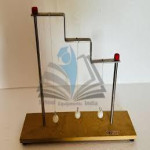
Electric Crane Model Manufacturer,Supplier and Exporter in India

Electric Crane Model

Product Code : SCL-EE-12503

The Electric Crane Model is an educational physics and STEM demonstration model used to explain powered lifting, force, motion, and energy conversion in a visible classroom format. It is intended for schools, physics laboratories, STEM labs, teachers, students, science clubs, and institutional buyers seeking a practical teaching aid for introductory mechanics and engineering concepts.

Product Description

The Electric Crane Model helps learners observe how electrical input can produce mechanical lifting action. During a supervised demonstration, students can connect the model to topics such as force, motion, lifting mechanisms, energy conversion, and the practical role of simple machines.

School Equipments supplies this model as part of its broader range of educational science apparatus. For related learning pathways, buyers can explore physics laboratory equipment and the STEM Lab Kit range. Because no verified load capacity, voltage, material, dimensions, or weight were supplied for this specific model, those values are not claimed here.

Key Features

  • Hands-on mechanics learning: Demonstrates the basic principle of lifting a load through a crane-type mechanism.
  • Energy conversion concept: Supports explanation of how electrical energy can be converted into mechanical motion.
  • Visible classroom demonstration: Makes force, motion, load lifting, and mechanism operation easier to observe.
  • STEM teaching value: Suitable for introductory physics, engineering, technology, and activity-based learning.
  • Related simple-machine learning: Can be taught alongside a wheel and axle model and a block and tackle model.
  • Specification transparency: Unverified capacity, voltage, material, and dimensional claims are intentionally excluded.

Technical Specifications

Specification

Detail

Product Name

Electric Crane Model

Brand

School Equipments

Product Category

Educational Physics Model / STEM Mechanics Demonstration Model

Primary Function

Demonstration of powered lifting, force, motion, and energy conversion

What's Included in the Kit

  • One Electric Crane Model.
  • Any separate power source, control unit, demonstration load, cable, manual, or accessory should be confirmed against the final supplied configuration before publication or ordering.

Applications / Uses

  • Classroom explanation of lifting mechanisms and crane operation.
  • Demonstration of electrical-to-mechanical energy conversion.
  • Introductory lessons on force, motion, work, load handling, and simple machines.
  • STEM activities, science clubs, project demonstrations, and teacher-led laboratory sessions.

How to Use the Electric Crane Model

  1. Place the model on a stable, level surface.
  2. Inspect the lifting mechanism and electrical connections before use.
  3. Use only the manufacturer-specified power source and operating instructions.
  4. Do not attach a load until the verified rated load capacity is known.
  5. Activate the model according to the supplied instructions and observe the lifting or lowering action.
  6. Relate the observed movement to force, motion, work, energy conversion, and simple-machine principles.

Safety note: Use under teacher or trained adult supervision. Keep fingers, loose clothing, and hair away from moving parts. Do not overload the model or use an unverified voltage.

Care & Maintenance

  • Keep the model clean, dry, and protected from dust after use.
  • Inspect moving parts, lifting elements, and electrical connections before each demonstration.
  • Store in a dry place and avoid impact, excessive load, or unauthorized modification.

Why Choose School Equipments

School Equipments is a manufacturer and exporter of scientific laboratory instruments, experiment setups, science kits, mathematics kits, didactic models, and STEM models and kits. The brand serves educational institutions and procurement buyers that require practical classroom and laboratory equipment. Its product range supports science teaching across physics, chemistry, biology, mathematics, and STEM learning. Buyers should confirm model-specific electrical ratings, capacities, materials, and supplied accessories before final procurement.

Frequently Asked Questions

What is an Electric Crane Model used for?

It is used to demonstrate powered lifting, force, motion, and energy conversion in school physics and STEM lessons.

Can the Electric Crane Model explain energy conversion?

Yes. It can support a teacher-led explanation of how electrical input produces mechanical motion in a lifting mechanism.

What is the lifting capacity of this Electric Crane Model?

No verified load capacity was supplied for this product. The rated capacity should be confirmed before attaching any demonstration load.

What voltage does the model require?

The operating voltage is not specified in the supplied product data. Use only the voltage stated by the manufacturer for the final supplied unit.

Is the model suitable for school students?

Yes, as a supervised educational demonstration model. Students should use it only under teacher or trained adult supervision.

Which topics can teachers cover with this model?

Relevant topics include force, motion, work, lifting mechanisms, simple machines, and electrical-to-mechanical energy conversion.

For broader classroom experiments and mechanics teaching aids, explore the School Equipments physics range.

   
Supply of Electric Crane Model from to Finland, France, Tanzania, Thailand, Sri Lanka, Congo, Costa Rica, Ivory Coast, Croatia, Cuba, Cyprus, Czech Republic, Denmark, Djibouti, Dominica, Afghanistan, Albania, Algeria, Andorra, Angola, Antigua and Barbuda, Argentina, Armenia, Australia, Austria, Azerbaijan, Bahamas, Bahrain, Bangladesh, Barbados, United Arab Emirates (UAE, Dubai), United Kingdom (London), United States, Uruguay, Uzbekistan, Vanuatu, Belarus, Belgium, Belize, Benin, Bhutan, Bolivia, Bosnia and Herzegovina, Botswana, Brazil, Brunei, Bulgaria, Burkina Faso, Burma Myanmar, East Timor, Ecuador, Egypt, El Salvador, Equatorial Guinea, Eritrea, Estonia, Ethiopia (Addis Ababa), Fiji, Burundi, Cambodia, Cameroon, Canada, Cape Verde, Central African Republic, Chad, Chile, Colombia. Math Teaching Kit suppliers in Luxembourg, Macedonia, Madagascar, Malawi (Lilongwe), Malaysia (Kuala Lumpur), Maldives, Mali, Malta, Marshall Islands, Mauritania, Mexico, Micronesia, Moldova, Monaco, Mongolia, Montenegro, Morocco, Mozambique, Namibia, Comoros, Congo. Math Teaching Kit manufacturers in Dominican Republic, Gabon, Gambia, Georgia, Germany, Ghana, Greece, Grenada, Guatemala, Guinea, Guinea-Bissau, Guyana, Haiti, Honduras, Hungary, Iceland, Indonesia, Iran, Iraq, Niger, Nigeria (Abuja), Norway, Oman, Palau, Panama, Papua New Guinea, Paraguay, Peru, Philippines (Manila), Poland, Ireland, Israel, Italy, Jamaica, Japan, Jordan, Kazakhstan, Kenya (Nairobi), Kiribati, Korea, Kuwait, Kyrgyzstan, Laos, Latvia, Lebanon, Lesotho, Liberia, Liechtenstein, Lithuania, Mauritius, Nauru, Nepal, Netherlands, New Zealand, Nicaragua, Portugal, Qatar, Romania, Russia, Rwanda (Kigali). Math Teaching Kit exportets to Saint Kitts and Nevis, Saint Lucia, Saint Vincent and the Grenadines, Samoa, San Marino, Sao Tome and Principe, Saudi Arabia, Senegal, Serbia, Seychelles, Sierra Leone, Singapore, Slovakia, Slovenia, Solomon Islands, Somalia, South Africa, South Sudan, Spain, Sudan, Suriname, Swaziland, Sweden, Switzerland, Syria, Tajikistan, Togo, Tonga, Trinidad and Tobago, Tunisia, Turkey, Turkmenistan, Tuvalu, Uganda (Kampala), Ukraine, Venezuela, Vietnam, Yemen , Zambia (Lusaka), Zimbabwe

Office Address

Works:

[email protected]

Follow Us