
Powell’s Wave Demonstrator
 (1).png)
Product Code : SCL-W-12291
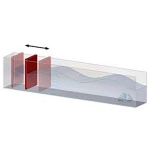
The Powell’s Wave Demonstrator is a physics laboratory apparatus used for demonstrating transverse wave motion, longitudinal wave motion, phase difference, amplitude, wavelength, and wave propagation. It is designed for school physics labs, college practical rooms, STEM classrooms, and teachers who need a visible mechanical model for explaining wave behaviour.
Product Description
The Powell’s Wave Demonstrator helps students observe how a disturbance can travel through a system while individual parts oscillate in a regular pattern. It converts abstract wave diagrams into a moving classroom demonstration, making concepts such as crest, trough, compression, rarefaction, phase, and energy transfer easier to understand.
Powell-type wave apparatus commonly uses a rotating handle, eccentric discs or cams, and linked rods to create visible wave motion. This model can be used with physics waves apparatus, Wave Motion Apparatus – 18 Pulleys, Wave Motion Apparatus – 24 Pulleys, and Transverse and Longitudinal Wave Using Slinky supplied by School Equipments.
Key Features
- Mechanical wave demonstrator for teaching transverse and longitudinal wave motion.
- Single apparatus format suitable for teacher demonstrations and student observation.
- Helps explain amplitude, wavelength, frequency, phase difference, crest, and trough.
- Supports observation of compression and rarefaction in longitudinal wave demonstrations.
- Useful for connecting wave diagrams with real moving mechanical parts.
- Manual operation supports classroom use without complex electronic setup.
- Suitable for school physics labs, STEM rooms, science exhibitions, and practical lessons.
Technical Specifications
|
Specification |
Detail |
|
Product Name |
Powell’s Wave Demonstrator |
|
Primary Keyword |
Powell’s Wave Demonstrator |
|
Product Category |
Physics > Waves / Wave Motion Demonstration Apparatus / STEM Teaching Aid |
|
Capacity / Pack Format |
Single wave motion teaching apparatus |
|
Learning Principle |
Transverse waves, longitudinal waves, oscillation, phase, amplitude, wavelength, and wave propagation |
|
Intended Users |
School physics labs, college practical rooms, science teachers, STEM educators, students, laboratory planners |
|
Secondary Keywords |
Powell wave apparatus, wave motion demonstrator, transverse wave model, longitudinal wave model, physics wave apparatus, mechanical wave demonstrator |
|
Operating Method |
Manual rotating handle or crank mechanism |
|
Wave Elements |
Rods, cams, eccentric discs, pulleys, or linked moving sections |
|
Brand |
School Equipments |
What's Included in the Kit
- 1 Powell’s Wave Demonstrator
- Frame and base assembly
- Rotating handle or crank
- Wave rods, cams, eccentric discs, or linked elements
- Longitudinal-wave guide arrangement
- Angle scale, phase scale, or pointer: [confirm if supplied]
- Instruction sheet or experiment guide
Applications / Uses
- Demonstrating transverse wave motion in school physics laboratories.
- Showing longitudinal wave motion, compression, and rarefaction.
- Teaching wave propagation, phase difference, amplitude, wavelength, and frequency.
- Explaining how particles oscillate while wave energy moves through a medium.
- Supporting STEM activities, science exhibitions, and classroom demonstrations.
- Helping students compare moving wave models with textbook wave diagrams.
How to Use the Powell’s Wave Demonstrator
- Place the apparatus on a stable laboratory bench where all students can see it clearly.
- Check that the rods, handle, frame, and moving sections are correctly aligned.
- Turn the handle slowly to produce a visible wave pattern.
- Ask students to identify crest, trough, wavelength, amplitude, and phase difference.
- Use the longitudinal-wave section, if supplied, to show compression and rarefaction.
- Repeat at different turning speeds and compare the visible wave behaviour.
Use the apparatus under teacher supervision. Keep fingers, loose clothing, and small objects away from moving rods, cams, pulleys, and crank sections during operation.
Care & Maintenance
- Store the demonstrator in a dry physics lab cabinet after use.
- Keep moving rods, cams, guides, pulleys, and handle sections free from dust.
- Do not force the crank if the mechanism feels blocked or misaligned.
- Check screws, guides, rods, and base stability before repeated demonstrations.
Why Choose School Equipments
School Equipments supplies scientific laboratory instruments, physics apparatus, wave-motion models, science kits, STEM models, didactic models, and classroom teaching aids for educational institutions. The brand supports practical learning across physics, chemistry, biology, mathematics, STEM, and laboratory setup categories.
The Powell’s Wave Demonstrator is suited to schools that want students to see wave motion through direct mechanical movement rather than static diagrams alone. Exact mechanism, number of rods, material, size, scale arrangement, packaging, and tender documentation should be confirmed before institutional purchase.
Frequently Asked Questions
What is a Powell’s Wave Demonstrator used for?
A Powell’s Wave Demonstrator is used to show wave motion mechanically. It helps students observe transverse waves, longitudinal waves, amplitude, wavelength, phase, and wave propagation.
Which waves can teachers demonstrate with this model?
Teachers can demonstrate transverse wave motion and, if the supplied model includes the required guide arrangement, longitudinal wave motion with compression and rarefaction.
Does the Powell’s Wave Demonstrator require electricity?
Most Powell-type wave demonstrators are manually operated with a rotating handle or crank. Buyers should confirm whether the supplied model is manual or motorised.
Is this apparatus suitable for school physics labs?
Yes. It is suitable for school physics labs, college practical rooms, STEM classrooms, and science exhibitions where wave motion needs to be demonstrated visually.
What concepts can students learn from this apparatus?
Students can learn wave propagation, oscillation, amplitude, wavelength, frequency, phase difference, crest, trough, compression, rarefaction, and energy transfer.
What should buyers confirm before ordering?
Buyers should confirm number of rods, operating mechanism, material, dimensions, angle scale, included accessories, packaging, and any required tender or export documentation.
Request the Powell’s Wave Demonstrator for your physics laboratory or explore more physics waves apparatus for school labs.
Suggested Product Image ALT Text: Powell’s Wave Demonstrator for school physics lab transverse and longitudinal wave motion experiments
.jpg)
 (1).png)
 (1).png)
.png)

.jpg)
