Kinetic Theory Model Manufacturer,Supplier and Exporter in India
Product Code : EL-MTP-11657
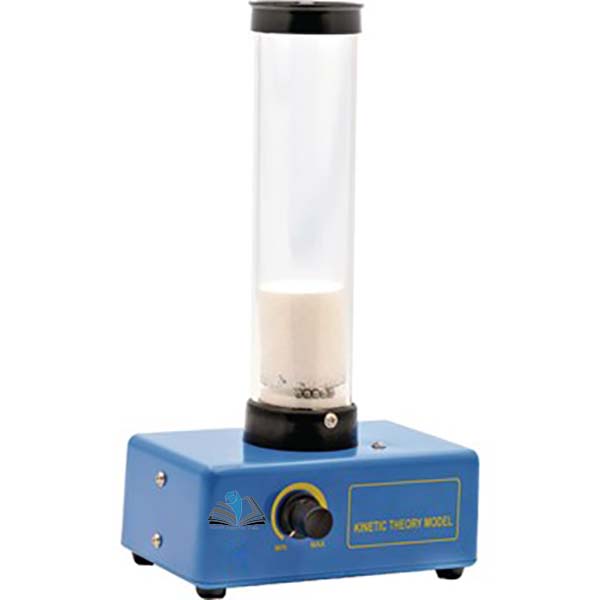
The Kinetic Theory Model is a physics demonstration apparatus used for showing random molecular motion, particle collisions, gas pressure and temperature effects. It is designed for school physics laboratories, science classrooms, STEM labs and supervised practical demonstrations. The moving particles make microscopic gas behaviour visible and easier for students to understand.
Product Description
The Kinetic Theory Model uses small particles or beads moving inside a transparent chamber to represent gas molecules. A vibration mechanism transfers energy to the particles, causing random movement and repeated collisions with other particles and the chamber walls. These observable collisions provide a mechanical analogy for molecular motion and gas pressure.
Teachers can vary the operating input when the supplied configuration includes adjustment. Faster particle movement represents increased molecular kinetic energy at a higher temperature. The apparatus supports lessons on kinetic theory, diffusion, Brownian motion, pressure, temperature and states of matter. Related products are available in the physics laboratory equipment category and the laboratory equipment range.
Key Features
- Visible particle motion: The transparent chamber allows students to observe random movement and collisions directly.
- Gas-pressure demonstration: Particle impacts against the chamber walls model how gas molecules exert pressure.
- Temperature analogy: Increased vibration produces faster movement, representing increased molecular kinetic energy.
- Classroom-friendly operation: The apparatus converts an abstract microscopic process into a visible demonstration.
- Multiple learning topics: Supports kinetic theory, molecular motion, diffusion, collisions and states of matter.
- Reusable teaching aid: Suitable for repeated teacher demonstrations and supervised student observations.
- Institutional application: Designed for physics laboratories, STEM programmes, science exhibitions and activity-based learning.
Technical Specifications
|
Specification |
Detail |
|
Product name |
Kinetic Theory Model |
|
Brand |
School Equipments India |
|
Product category |
Physics Laboratory Models and STEM Teaching Aids |
|
Working principle |
Vibrated particles simulate constant random molecular motion and collisions |
|
Observation chamber |
Transparent chamber; dimensions and capacity |
|
Particle type and quantity |
Small particles or beads; specification |
|
Operating mechanism |
Vibration mechanism with control arrangement |
|
Power requirement |
Battery or suitable low-voltage supply, depending on supplied model |
|
Construction material |
Educational-grade components; exact materials |
|
Standards or certifications |
Not specified |
What's Included in the Kit
- Transparent particle-observation chamber
- Small demonstration particles or beads
- Vibration mechanism
- Base unit
- Control arrangement
- Power accessory and operating instructions
Applications and Uses
- Demonstrating random molecular motion in gases
- Explaining how particle collisions produce gas pressure
- Relating temperature to average molecular kinetic energy
- Introducing diffusion and Brownian-motion concepts
- Comparing particle behaviour in solids, liquids and gases
- Supporting physics practicals, STEM activities and science exhibitions
How to Use the Kinetic Theory Model
- Place the apparatus on a clean, level and stable laboratory table.
- Check that the chamber, particles and moving components are securely fitted.
- Connect only the recommended battery or low-voltage power supply, if required.
- Switch on or activate the vibration mechanism.
- Observe the random movement and collisions inside the chamber.
- Explain that the particles represent gas molecules in continuous motion.
- Adjust the vibration level, when available, and compare particle speeds.
- Switch off the apparatus after the demonstration and disconnect its power source.
Safety note: Operate the model under teacher or laboratory-instructor supervision. Do not connect it directly to mains electricity unless the supplied specification explicitly permits it. Do not open the chamber while the vibration mechanism is operating.
Care & Maintenance
- Clean the chamber and base with a soft, dry cloth.
- Keep moisture, liquids and laboratory chemicals away from the mechanism.
- Do not apply excessive force to the chamber or controls.
- Store the model in a clean, dry cabinet after disconnecting the power source.
Why Choose School Equipments India?
School Equipments India manufactures, supplies and exports scientific and educational laboratory equipment for institutional use. Its range supports schools, colleges, universities, STEM laboratories and science-education projects. Buyers can review the complete scientific and educational product catalogue or submit chamber, power and component requirements through the product enquiry page.
Frequently Asked Questions
What does a Kinetic Theory Model demonstrate?
It demonstrates random particle movement, molecular collisions, gas pressure and the effect of increased energy on particle speed.
What do the moving beads represent?
The moving beads represent gas molecules. Their impacts against one another and the chamber walls model molecular collisions.
How does the model explain temperature?
Increasing the vibration makes the particles move faster. This represents the increase in average molecular kinetic energy associated with a higher temperature.
Does the Kinetic Theory Model require electricity?
The power arrangement depends on the supplied design. A battery or suitable low-voltage power supply may be required and must be confirmed before use.
Can students operate the apparatus?
Students can operate or observe the model under qualified supervision. The chamber and moving mechanism should remain closed during operation.
Is it suitable for a school physics laboratory?
Yes. It is intended for school physics laboratories, science classrooms, STEM programmes, colleges and demonstration activities.
Request the verified chamber size, power requirement and component configuration from School Equipments India, or explore the physics laboratory equipment category.
Recommended Product Image ALT Text
- Kinetic Theory Model with transparent particle observation chamber
- Physics laboratory apparatus demonstrating random molecular motion
- Kinetic theory of gases model showing moving particle collisions
- STEM teaching model for gas pressure and temperature demonstrations