
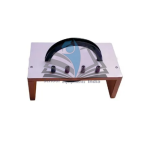
Eddy Current Model (Disc Type)
.png)
Product Code : SCL-EE-12161
The Eddy Current Model (Disc Type) by School Equipments India is an educational physics demonstration model designed to explain eddy currents, electromagnetic induction, magnetic damping, Lenz’s law, and the effect of magnetic fields on moving conductors. It is widely used in school physics laboratories, science classrooms, STEM labs, and science exhibitions to help students understand how induced currents are produced in a conducting disc.
This model provides a practical and visual demonstration of how a rotating metal disc behaves when placed in a magnetic field. When the conducting disc moves through the magnetic field, circulating currents called eddy currents are induced in the disc. These currents create an opposing magnetic effect, which can slow down the motion of the disc. This makes the apparatus useful for teaching electromagnetic braking, magnetic damping, and practical applications of induction.
The Eddy Current Model (Disc Type) is a physics teaching model used to demonstrate the formation and effect of eddy currents in a rotating metallic disc. The model generally consists of a metal disc, rotating spindle or axle, support frame, magnet arrangement, handle or drive mechanism, and base stand as per the supplied design.
When the disc is rotated freely, it continues spinning for some time. However, when a strong magnet is brought near the moving disc, eddy currents are produced inside the conducting material. According to Lenz’s law, these induced currents oppose the motion that produces them, causing the disc to slow down. This visible reduction in speed helps students clearly understand magnetic braking and electromagnetic damping.
The School Equipments India Eddy Current Model (Disc Type) is suitable for classroom demonstrations, physics practicals, STEM learning activities, and science project displays. It connects theoretical concepts of electromagnetic induction with real-life applications such as electric brakes, speedometers, induction furnaces, metal detectors, and energy meters.
The Eddy Current Model (Disc Type) is an important physics teaching aid because it helps students observe the effect of induced currents in a conductor. Eddy currents are not directly visible, but their effect can be seen when the rotating disc slows down in the presence of a magnetic field.
Teachers can use this model to explain electromagnetic induction, Lenz’s law, magnetic damping, energy conversion, and electromagnetic braking. It also helps students understand real-life applications such as train braking systems, electric meters, induction heating, metal detection, and damping systems in instruments.
The Eddy Current Model (Disc Type) is a reliable physics lab model for schools looking for practical electromagnetic induction demonstration equipment. It helps students understand eddy currents, magnetic damping, Lenz’s law, induced current, rotating conductors, and electromagnetic braking through hands-on classroom observation. This model is suitable for science teachers, school laboratories, STEM programs, educational institutions, and science exhibition demonstrations.
School Equipments India supplies educational science models, physics laboratory apparatus, electromagnetism demonstration models, STEM kits, laboratory equipment, geography models, and classroom teaching aids for schools and institutions. The Eddy Current Model (Disc Type) is designed for practical classroom use and supports clear explanation of electromagnetic induction and magnetic damping concepts.
This product content supports Google E-E-A-T guidelines by providing clear product information, accurate educational purpose, practical usage instructions, product specifications, safety guidance, and relevant classroom applications. The content is written for science teachers, school buyers, STEM educators, laboratory planners, and educational institutions looking for dependable physics demonstration models.
Eddy Current Model Disc Type, eddy current model for school lab, eddy current apparatus, electromagnetic induction model, magnetic damping model, Lenz’s law demonstration model, electromagnetic braking apparatus, physics lab eddy current model, STEM physics teaching aid, School Equipments India Eddy Current Model.
An Eddy Current Model (Disc Type) is a physics demonstration model used to show how eddy currents are produced in a rotating conducting disc placed in a magnetic field.
It is used to teach students about eddy currents, electromagnetic induction, magnetic damping, Lenz’s law, and electromagnetic braking.
It demonstrates electromagnetic induction and Lenz’s law, where induced currents oppose the change or motion that produces them.
The rotating disc slows down because eddy currents are induced in the conducting disc. These currents create an opposing magnetic effect that resists the motion.
No, the basic Eddy Current Model (Disc Type) is manually operated and does not require electricity for standard demonstrations.
Eddy currents are circulating electric currents induced inside a conductor when it moves through a magnetic field or experiences a changing magnetic field.
Yes, it is suitable for school physics laboratories, science classrooms, STEM labs, colleges, and practical demonstrations.
Yes, students can observe and operate the model under teacher supervision. Care should be taken around the rotating disc and magnets.
Teachers can explain eddy currents, electromagnetic induction, Lenz’s law, magnetic damping, induced current, conductors, and electromagnetic braking.
This Eddy Current Model (Disc Type) is supplied by School Equipments India.
Eddy Current Model Disc Type for School Physics Laboratory
Product Description
Key Features
Product Specifications
Product Name
Eddy Current Model (Disc Type)
Brand
School Equipments India
Category
Physics Lab Model / Electromagnetic Induction Model / STEM Teaching Aid
Application
Demonstration of eddy currents, magnetic damping, Lenz’s law, and electromagnetic braking
Working Principle
A moving conducting disc in a magnetic field produces induced circulating currents that oppose the motion
Main Components
Conducting metal disc, rotating axle or spindle, magnet arrangement, support frame, handle or drive system, and base stand as per supplied model
Suitable For
Schools, colleges, physics laboratories, science classrooms, STEM labs, and science exhibitions
Usage Type
Manual physics demonstration and practical model
Learning Topics
Eddy currents, electromagnetic induction, Lenz’s law, magnetic damping, magnetic field, conductors, and braking effect
Power Requirement
No electricity required for basic manual demonstration
Material
Durable educational-grade components; specifications may vary as per supplied model
Packaging
Securely packed for safe transportation and institutional supply
How to Use the Eddy Current Model (Disc Type)
Safety and Handling Instructions
Educational Importance
Applications
SEO-Friendly Product Benefits
Why Choose School Equipments India?
E-E-A-T Content Note
SEO Keywords
Frequently Asked Questions
1. What is an Eddy Current Model (Disc Type)?
2. What is the use of this model in schools?
3. Which principle does the Eddy Current Model demonstrate?
4. Why does the rotating disc slow down near a magnet?
5. Does this model require electricity?
6. What are eddy currents?
7. Is this model suitable for school physics laboratories?
8. Can students operate the Eddy Current Model?
9. What topics can teachers explain using this model?
10. Which brand supplies this Eddy Current Model (Disc Type)?


.jpg)
 (1).png)
.jpg)

