Hand Driven Van De Graaff Generator
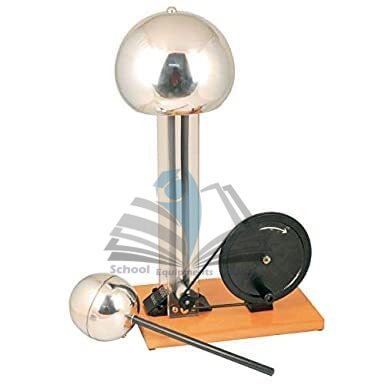
Product Code : SCL-EE-12120
The Hand Driven Van De Graaff Generator by School Equipments India is an educational physics apparatus designed to demonstrate the principles of static electricity, electric charge generation, electrostatic force, charge transfer, and electric potential. It is a useful teaching model for school physics laboratories, science classrooms, STEM labs, and science exhibitions.
This hand-operated Van De Graaff Generator allows students to observe electrostatic effects in a safe and practical classroom environment. By rotating the handle manually, the belt mechanism transfers electric charge to the metal dome, creating a visible demonstration of static electricity. It helps teachers explain important physics topics such as charge accumulation, repulsion, attraction, electric field, and discharge.
A Van De Graaff Generator is a scientific instrument used to generate high voltage static electricity at low current. The hand driven model works without external power supply, making it suitable for school demonstrations and basic laboratory experiments. When the handle is rotated, an insulating belt moves over rollers and transfers electric charge to the hollow metallic dome. The charge gradually builds up on the outer surface of the dome due to electrostatic principles.
The apparatus can be used to demonstrate several electrostatic phenomena, such as hair standing on end, attraction of small paper pieces, movement of lightweight objects, electric spark discharge, and repulsion between similarly charged objects. These demonstrations help students understand concepts that are difficult to visualize through textbooks alone.
The Hand Driven Van De Graaff Generator is ideal for practical learning because it combines simple mechanical operation with clear electrostatic results. It supports activity-based education and helps students connect theoretical physics concepts with observable experiments.
The Hand Driven Van De Graaff Generator is an important apparatus for teaching electrostatics in a clear and practical manner. It helps students observe how electric charges behave, how similar charges repel each other, and how charge can accumulate on a conductor. Such demonstrations make physics lessons more interactive and easier to understand.
Teachers can use this model to explain static electricity, charging by friction, charge transfer, electric potential, electric field, conductors, insulators, and electrostatic discharge. The apparatus is especially useful for introducing students to high-voltage, low-current electrostatic phenomena in a controlled classroom setting.
The Hand Driven Van De Graaff Generator is a practical physics lab apparatus for schools looking for reliable electrostatics demonstration equipment. It helps students understand static electricity, electric charge generation, electric field effects, and electrostatic discharge through hands-on observation. This model is suitable for physics teachers, school laboratories, educational institutions, STEM programs, and science fair demonstrations.
School Equipments India supplies educational science models, physics lab apparatus, laboratory instruments, STEM kits, geography models, and classroom teaching aids for schools and institutions. The Hand Driven Van De Graaff Generator is designed for educational use and supports clear demonstration of electrostatic principles in physics laboratories.
This product content is written to support Google E-E-A-T guidelines by providing clear product information, practical usage details, safety guidance, educational applications, and relevant specifications. The description focuses on accurate learning value, classroom use, and institutional suitability for buyers such as schools, colleges, laboratory planners, and science educators.
Hand Driven Van De Graaff Generator, Van De Graaff Generator for school lab, electrostatics demonstration apparatus, static electricity model, physics lab equipment, high voltage electrostatic generator, hand operated Van De Graaff Generator, science exhibition physics model, STEM physics apparatus, School Equipments India Van De Graaff Generator.
A Hand Driven Van De Graaff Generator is a physics laboratory apparatus used to generate static electricity manually through a rotating belt mechanism and metal dome.
It is used to demonstrate static electricity, charge transfer, electrostatic attraction, repulsion, electric field, and spark discharge in physics classrooms and laboratories.
No, this is a hand-driven model. It is operated manually by rotating the handle, so it does not require an external power supply for basic demonstrations.
It explains electrostatic charge generation and charge transfer. The moving belt carries charge to the metal dome, where charge accumulates on the outer surface.
Yes, it is suitable for educational demonstrations when used under teacher supervision. Proper safety precautions should always be followed.
Yes, under suitable dry conditions, the charged dome may produce small electrostatic sparks when discharged using an appropriate discharge accessory.
Hair strands receive similar charges and repel each other. This repulsion makes the hair strands move apart and stand up.
Yes, the Hand Driven Van De Graaff Generator is a popular and effective model for science exhibitions, physics demonstrations, and STEM learning activities.
Teachers can explain static electricity, conductors, insulators, electric charge, electric potential, electric field, attraction, repulsion, and electrostatic discharge.
This apparatus is supplied by School Equipments India.
Hand Driven Van De Graaff Generator for School Physics Laboratory
Product Description
Key Features
Product Specifications
Product Name
Hand Driven Van De Graaff Generator
Brand
School Equipments India
Category
Physics Lab Apparatus / Electrostatics Demonstration Model / STEM Teaching Aid
Application
Demonstration of static electricity, charge generation, electric field, and electrostatic discharge
Operation Type
Manual hand-driven operation
Working Principle
Electrostatic charge transfer using moving belt mechanism
Main Components
Metal dome, insulating belt, rollers, hand crank, support column, base, and discharge accessory arrangement
Suitable For
Schools, colleges, physics laboratories, STEM labs, science exhibitions, and classroom demonstrations
Power Requirement
No external power required for hand-driven operation
Usage Type
Educational demonstration apparatus
Material
Durable educational-grade components; specifications may vary as per model design
Packaging
Securely packed for safe institutional delivery
How to Use the Hand Driven Van De Graaff Generator
Safety Instructions
Educational Importance
Applications
SEO-Friendly Product Benefits
Why Choose School Equipments India?
E-E-A-T Content Note
SEO Keywords
Frequently Asked Questions
1. What is a Hand Driven Van De Graaff Generator?
2. What is the use of this apparatus in schools?
3. Does this model require electricity?
4. Which principle does the Van De Graaff Generator explain?
5. Is it safe for students?
6. Can it produce sparks?
7. Why does hair stand up near a Van De Graaff Generator?
8. Can this apparatus be used in science exhibitions?
9. What topics can teachers explain using this model?
10. Which brand supplies this Hand Driven Van De Graaff Generator?


.jpg)
-Photoroom (1).png)


 (1).png)