
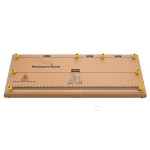
Plug-In Resistance Measurement Box
.jpg)
Product Code : SCL-EE-12716
The Plug-In Resistance Measurement Box is a physics laboratory apparatus used to insert known resistance values into electric circuits for Ohm’s law, resistance comparison, Wheatstone bridge work, current control, and practical electricity experiments. It is suitable for schools, colleges, physics labs, STEM classrooms, distributors, and institutional procurement teams.
Product Description
Plug-In Resistance Measurement Box from School Equipments India is intended for supervised physics and electrical laboratory use. A plug-in resistance box normally uses removable plugs or link contacts to select resistance values, but the exact range, step values, tolerance, power rating, terminals, case material, dimensions, and calibration status must be confirmed from the final supplied product.
This apparatus helps students connect circuit theory with measurable laboratory behaviour. It supports lessons on resistance, voltage, current, Ohm’s law, circuit design, bridge methods, and measurement accuracy. It should not be described as a certified calibration standard unless a valid calibration certificate or test report is supplied.
Key Features
- Plug-in resistance selection: designed for inserting known resistance values into educational circuits.
- Physics lab application: supports Ohm’s law, circuit resistance, current control, and voltage-drop demonstrations.
- Bridge-method support: useful for Wheatstone bridge and resistance-comparison experiments where the range is suitable.
- Classroom measurement value: helps students compare calculated resistance with observed current and voltage readings.
- Low-voltage practical use: intended for supervised school and college laboratory circuits.
- Range to confirm: resistance range, step values, tolerance, and rating must be verified before publishing.
- Construction to confirm: plug contacts, terminals, internal coils, case material, and insulation details should be checked.
Technical Specifications
|
Specification |
Detail |
|
Product Name |
Plug-In Resistance Measurement Box |
|
Primary Keyword |
Plug-In Resistance Measurement Box |
|
Secondary / Semantic Keywords |
plug type resistance box, physics lab resistance box, resistance measurement apparatus, Ohm’s law resistance box, Wheatstone bridge resistance box, electrical resistance apparatus, school physics equipment, circuit resistance box |
|
Brand |
School Equipments India |
|
Product Category |
Physics Laboratory Equipment / Electricity Apparatus / Resistance Boxes |
|
Intended Users |
Schools, colleges, universities, physics laboratories, STEM classrooms, distributors, and educational procurement buyers |
|
Apparatus Type |
Plug-in / plug-type resistance measurement box |
What's Included in the Kit
- Plug-In Resistance Measurement Box
- Plug contacts, selector plugs, or link terminals
- Input and output terminals
- Product label with resistance and rating details
- Instruction sheet, test report, or calibration certificate
Applications / Uses
- Introducing known resistance values into school physics circuits
- Verifying Ohm’s law using voltage and current readings
- Supporting Wheatstone bridge and resistance-comparison experiments
- Studying current control by changing circuit resistance
- Demonstrating series, parallel, and practical electricity concepts
- Supplying physics laboratory apparatus for institutional tenders
How to Use the Plug-In Resistance Measurement Box
- Check the product label, resistance range, rating, and terminal condition before use.
- Keep the power supply switched off while making circuit connections.
- Connect the box in the required circuit position using suitable laboratory leads.
- Select the required resistance value using the plug or selector arrangement.
- Switch on only the approved low-voltage laboratory supply.
- Observe ammeter and voltmeter readings without exceeding the confirmed rating.
- Record values and compare measured results with Ohm’s law calculations.
- Switch off the supply before changing plugs, wiring, or storing the apparatus.
Safety note: Use only under teacher or laboratory-supervisor control. Do not overload the box, connect it directly to mains voltage, or touch terminals during live experiments.
Care & Maintenance
- Store in a dry, dust-free cabinet after practical sessions.
- Keep plugs, terminals, contact points, and selector areas clean and corrosion-free.
- Do not exceed the confirmed current, voltage, or power rating.
- Quarantine the apparatus if readings are unstable, plugs are loose, contacts overheat, or the case is damaged.
Why Choose School Equipments India
School Equipments India manufactures and exports scientific laboratory instruments, school laboratory equipment, science kits, mathematics kits, didactic models, and STEM models. The brand supports schools, colleges, universities, distributors, and institutional tender buyers with practical science teaching aids. For plug-in resistance apparatus, buyers should confirm resistance range, tolerance, rating, construction, calibration status, and packaging before procurement.
Frequently Asked Questions
What is a Plug-In Resistance Measurement Box used for?
A Plug-In Resistance Measurement Box is used to introduce known resistance values into physics lab circuits for Ohm’s law, current control, resistance comparison, and bridge experiments.
Is it suitable for school physics laboratories?
Yes. It is suitable for supervised school and college physics laboratories when used with approved low-voltage circuit setups and teacher guidance.
Can it be used for Wheatstone bridge experiments?
Yes. A plug-in resistance box can support Wheatstone bridge experiments when its resistance range, steps, and tolerance match the practical method.
What is the resistance range?
The resistance range is not confirmed. Add the exact ohm range and step values only after checking the final supplied product label.
Does it include calibration documentation?
Calibration documentation is not confirmed. Do not claim a calibration certificate, test report, or accuracy class unless supplied with the final product.
Can students change the plugs directly?
Students should change plugs only under supervision and only after the power supply is switched off. This prevents shock risk, contact damage, and incorrect readings.
For related practical science apparatus, explore school laboratory equipment, resistance board apparatus, STEM lab kits, and contact School Equipments India.


.png)