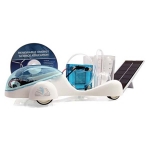
Hydraulic Press Model Manufacturer,Supplier and Exporter in India
Product Code : SCL-E-12517
The Hydraulic Press Model is an educational physics apparatus used for demonstrating Pascal's law, fluid pressure transmission and hydraulic force multiplication. It is intended for school physics laboratories, STEM classrooms, science teachers and introductory engineering demonstrations where learners need to observe how input force can produce a larger output force through a confined fluid system.
Product Description
The Hydraulic Press Model provides a practical demonstration of the operating principle behind hydraulic presses and other fluid-power systems. When pressure is applied to a confined liquid through an input piston, that pressure is transmitted through the fluid and can act on a second piston to produce mechanical movement.
In an ideal system with pistons of different cross-sectional areas, a larger output piston can produce greater force than the applied input force. The theoretical relationship is based on equal transmitted pressure, with force proportional to piston area. Exact piston dimensions, working fluid, load capacity, construction materials and pressure range must be confirmed for the final supplied model.
Key Features
- Demonstrates Pascal's law: shows how pressure applied to a confined liquid is transmitted through a hydraulic system.
- Explains force multiplication: supports practical study of how different piston areas can produce mechanical advantage.
- Visible hydraulic action: allows students to observe input movement and corresponding output-piston response.
- Connects theory with applications: helps explain hydraulic presses, jacks, brakes and lifting systems.
- Supports hands-on STEM learning: combines fluid pressure, force, piston area and mechanical movement in one demonstration.
- Suitable for group teaching: useful for school laboratories, STEM rooms, science exhibitions and introductory engineering lessons.
Technical Specifications
|
Specification |
Detail |
|
Product Name |
Hydraulic Press Model |
|
Brand |
School Equipments |
|
Product Category |
Physics Laboratory Equipment / Motion & Forces Apparatus / Hydraulic Pressure Demonstration Model |
|
Primary Keyword |
Hydraulic Press Model |
|
Secondary / Semantic Keywords |
hydraulic press apparatus, Pascal's law apparatus, fluid pressure model, hydraulic force multiplication, hydraulic mechanics model, STEM physics apparatus, pressure transmission experiment |
|
Intended Users |
Schools, physics laboratories, STEM educators, science teachers, introductory engineering classes and educational institutions |
|
Scientific Principle |
Pascal's law and hydraulic pressure transmission |
|
Standards or Certifications |
Not specified in the supplied product data |
What's Included in the Kit
- 1 Hydraulic Press Model main demonstration unit
- Input and output piston or cylinder arrangement
- Hydraulic tubing or fluid connection system
- Operating handle, lever or input mechanism
- Load platform or pressing arrangement
- Instruction sheet or experiment guide
Applications / Uses
- Demonstrating Pascal's law in school physics laboratories.
- Explaining hydraulic pressure transmission in a confined liquid.
- Teaching the relationship between force, pressure and piston area.
- Introducing hydraulic mechanical advantage and force multiplication.
- Comparing press operation with a DIY Hydraulic Jack Model.
- Studying another real-world application of Pascal's law with the Hydraulic Brake Model.
How to Use the Hydraulic Press Model
- Place the apparatus on a stable, level laboratory bench.
- Inspect all cylinders, pistons, tubing, joints and moving components before use.
- Confirm that the approved working fluid is correctly filled and that unwanted air is removed where required by the model design.
- Place only an approved demonstration load on the output platform, if provided.
- Apply force slowly through the input piston, lever or operating mechanism.
- Observe how hydraulic pressure produces movement or force at the output piston.
- Compare input and output behaviour and relate the observation to piston area, pressure and mechanical advantage.
Safety note: Use only under teacher or trained-laboratory supervision. Never exceed the confirmed pressure or load rating, place fingers beneath moving press components, disconnect filled tubing under pressure or use an unapproved working fluid.
Care & Maintenance
- Inspect pistons, seals, tubing and joints regularly for leakage or damage.
- Clean any spilled working fluid immediately and identify the source before reuse.
- Do not overload the press or apply sudden excessive force to the operating mechanism.
- Store the apparatus in a clean, dry location away from excessive heat, impact and corrosive chemicals.
Why Choose School Equipments
School Equipments manufactures and exports scientific laboratory instruments, physics apparatus, science kits, mathematics kits, didactic models and STEM equipment for educational use. Its catalogue includes practical models for demonstrating force, motion, pressure, hydraulics and mechanical systems.
Educators can compare hydraulic systems with the Hand Pump Model and explore the broader Motion & Forces Apparatus collection. Final load capacity, material, piston dimensions, pressure range, working fluid and included accessories should be confirmed before ordering.
Frequently Asked Questions
What is a Hydraulic Press Model used for?
A Hydraulic Press Model is used to demonstrate Pascal's law, hydraulic pressure transmission and the principle of force multiplication through pistons operating with a confined liquid.
How does a Hydraulic Press Model work?
Force applied to an input piston creates pressure in the confined working fluid. That pressure is transmitted through the hydraulic system and acts on the output piston to produce force and movement.
How does a hydraulic press multiply force?
In an ideal system, pressure is transmitted equally through the confined fluid. A larger-area output piston therefore produces a greater force than a smaller-area input piston, with theoretical force proportional to piston area.
What scientific principle does the apparatus demonstrate?
The apparatus demonstrates Pascal's law, which describes pressure transmission in a confined fluid. It can also support lessons on pressure, force, piston area and mechanical advantage.
Is the Hydraulic Press Model suitable for school physics laboratories?
Yes. It is suitable for supervised school physics practicals, STEM activities, science exhibitions and introductory lessons on hydraulics and applied mechanics.
What is the load capacity of the Hydraulic Press Model?
The exact load capacity was not provided in the supplied product data. This value should be added only after verification of the final model specification.
Explore the complete Motion & Forces Apparatus range from School Equipments for additional models covering force, pressure, hydraulics, motion and mechanics.