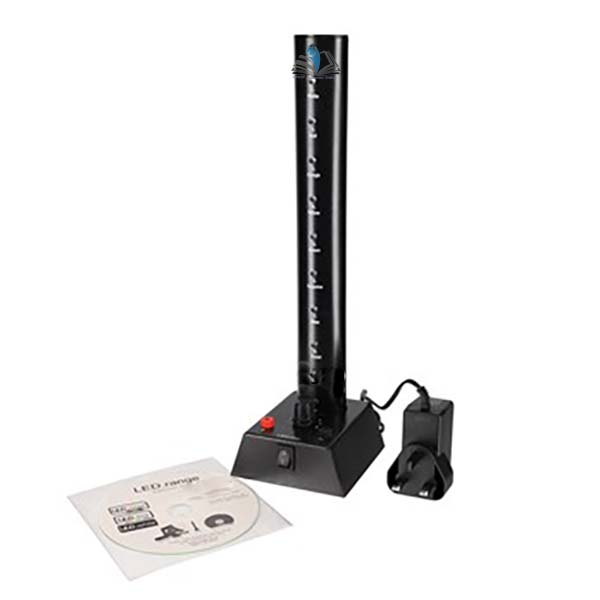
Quick Answer: The LED line Apparatus shows the relationship between colour and wavelength with seven coloured LEDs plus white in a vertical column, and a rotary switch to measure the voltage across each LED for finding Planck's Constant.
Last updated: October 2026
Key Features
Seven coloured LEDs plus white, spanning the visible spectrum
Vertical column that a whole class can view
Rotary switch selects each LED for voltage measurement
Planck's Constant determined from the LED voltages and wavelengths
First, second and third order fringes, depending on the diffraction grating used
5 V power supply and teacher's notes on CD included
About This Product
Besides determining Planck's Constant graphically, the apparatus can be used to explore the action of colour filters, demonstrate diffraction at different wavelengths and calculate the wavelength of each LED colour. The full set of experiments in the teacher notes also needs an Easy Read Meter, a 20V D.C. Easy Read Attachment, diffraction gratings, colour filters and connecting leads. Besides buyers across India, the LED line Apparatus can be exported to institutions in Benin, Colombia, Morocco, Malawi and Suriname.
Frequently Asked Questions
Q1. How is Planck's Constant found? The rotary switch selects each LED so the voltage across it can be measured. Using these voltages and the wavelength of each LED, Planck's Constant is determined graphically.



.png)
 (1).png)
 (1).png)

