Quick Answer: The Power Amplifier boosts audio sources and signal generators to 3.5Wrms into 4 ohm or 2Wrms into 8 ohm, and is particularly suitable for driving Vibration Generators and Rubens' tubes when a power signal generator is not available.
Last updated: October 2026
Key Features
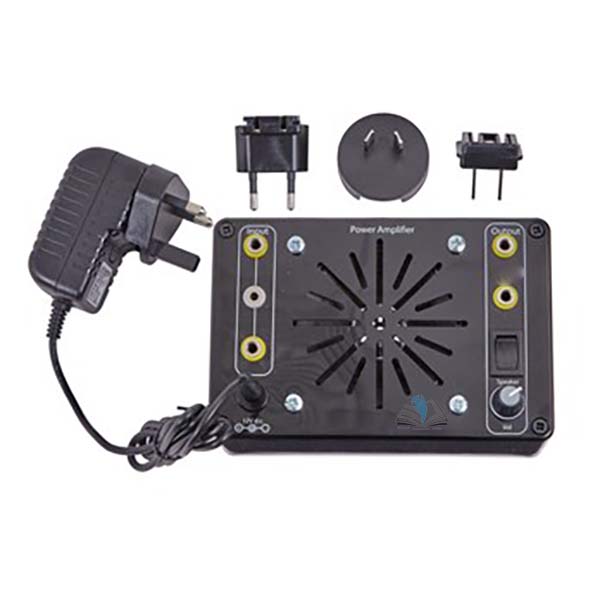
Internal 10W speaker that can be switched off when not required
Takes microphones and audio devices with a 3.5 mm headphone socket, and signal generators with 4 mm socket outputs
Outputs protected against overload and short circuit
Frequency response 20 Hz to 20 kHz (-3dB)
Signal-to-noise ratio 86dB (A weighted)
Runs from a 12Vdc supply
Technical Specifications
Specification
Value
Output
3.5Wrms / 4 ohm or 2Wrms / 8 ohm
Total harmonic distortion
0.05% (1W / 1kHz)
Frequency response
20Hz to 20kHz (-3dB)
Signal-to-noise ratio
86dB (A weighted)
Input sensitivity
40mV / 150 kohm
Supply voltage
12Vdc
About This Product
In the classroom, the amplifier lets students amplify and listen to a variety of audio sources, from microphones and personal audio devices to laboratory signal generators. Its main laboratory role is driving Vibration Generators and Rubens' tubes where no power signal generator is at hand.
Frequently Asked Questions
Q1. Can the Power Amplifier drive a Vibration Generator? Yes. It is particularly suitable for driving Vibration Generators and Rubens' tubes when a power signal generator is not available.
Q2. Can the internal speaker be turned off? Yes. The internal 10W speaker can be switched off when it is not required.

.jpeg)
.jpg)

.png)
 (1).png)

