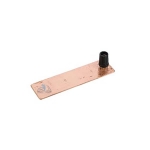
Hand Battery Apparatus
Product Code : SCL-EE-12174
The Hand Battery Apparatus by School Equipments India is an educational physics laboratory apparatus designed to demonstrate basic electrochemistry, electric current generation, human body conductivity, galvanic cell action, and the conversion of chemical energy into electrical energy. It is widely used in school science laboratories, physics classrooms, chemistry classrooms, STEM labs, and science exhibitions for practical demonstrations of simple electric cells.
This apparatus helps students understand how a small electric current can be produced when two different metals are connected through an electrolyte. In this demonstration, the moisture and salts present on the human hand can act as a weak electrolyte, allowing a small voltage to be generated between two metal plates. It is a simple and engaging teaching aid for introducing students to batteries, electrodes, electrolytes, and current flow.
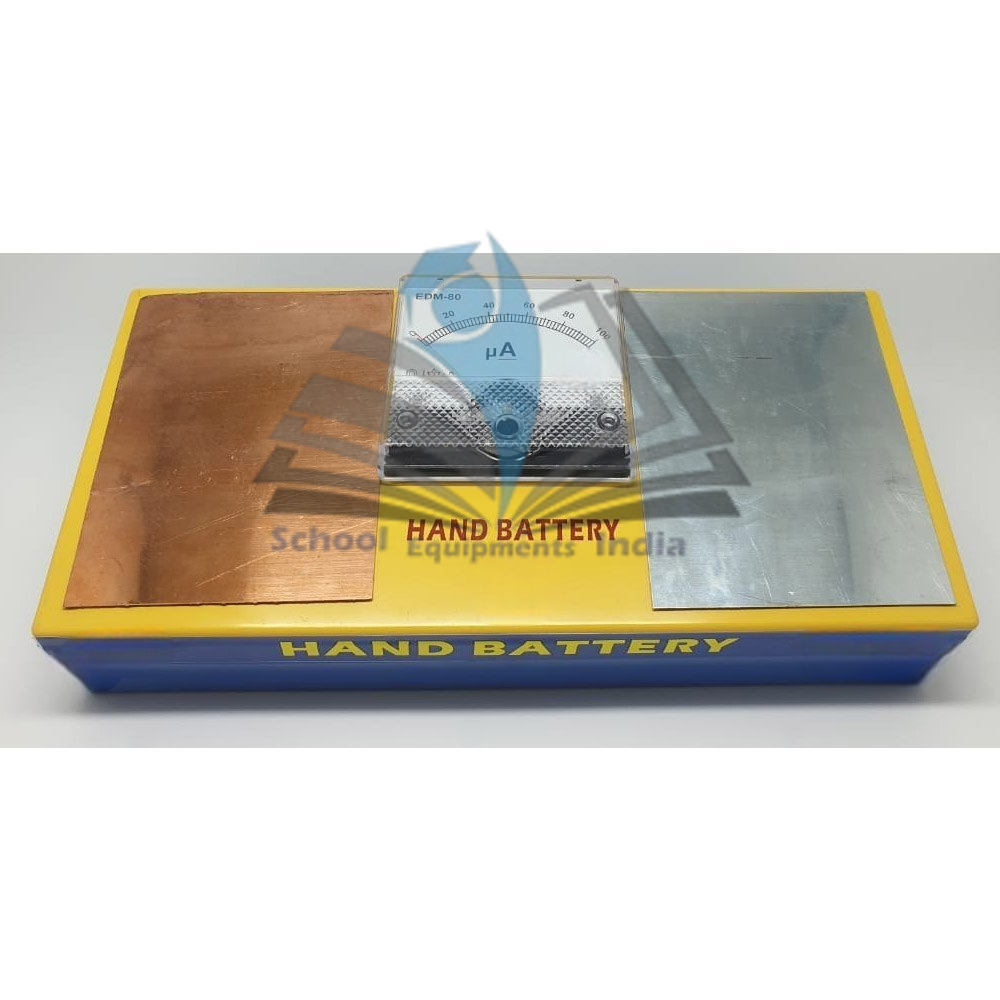
A Hand Battery Apparatus is a classroom demonstration model used to show that the human hand can complete an electrochemical circuit when placed on two different metal plates such as copper and zinc. The apparatus generally consists of a base board, two different metal electrodes, connecting terminals, wires, and a sensitive meter or indicator arrangement as per the supplied model design.
When a student places one hand or fingers on the metal plates, the natural moisture on the skin acts as an electrolyte. Due to the difference in electrode potential between the two metals, a small electric current is produced. This current can be observed using a galvanometer, microammeter, LED indicator, or suitable meter depending on the model configuration.
The School Equipments India Hand Battery Apparatus is useful for teaching electric cells, battery principle, electrode reaction, conductivity, current flow, and the role of electrolytes. It converts an abstract electricity concept into a direct and interactive classroom experiment.
The Hand Battery Apparatus is an important teaching aid because it allows students to experience the basic working principle of a battery through direct observation. It shows that electricity can be produced by chemical action between two different metals and an electrolyte.
Teachers can use this apparatus to explain simple cells, electrodes, electrolyte, voltage, current, conductivity, galvanic action, and energy conversion. It also helps students understand the basic science behind dry cells, batteries, electrochemical cells, and everyday electrical power sources.
The Hand Battery Apparatus is a reliable educational apparatus for schools looking for practical electricity and electrochemistry demonstration equipment. It helps students understand simple battery action, electrodes, electrolyte, current flow, voltage generation, human body conductivity, and chemical energy conversion through hands-on classroom observation. This apparatus is suitable for science teachers, school laboratories, STEM programs, educational institutions, and science exhibition demonstrations.
School Equipments India supplies educational science models, physics laboratory apparatus, chemistry demonstration equipment, STEM kits, laboratory instruments, geography models, and classroom teaching aids for schools and institutions. The Hand Battery Apparatus is designed for practical classroom use and supports clear explanation of electricity, batteries, and electrochemical cell concepts.
This product content supports Google E-E-A-T guidelines by providing clear product information, accurate educational purpose, practical usage instructions, product specifications, safety guidance, and relevant classroom applications. The content is written for science teachers, school buyers, STEM educators, laboratory planners, and educational institutions looking for dependable physics and electrochemistry demonstration apparatus.
Hand Battery Apparatus, hand battery model for school lab, simple cell apparatus, human body conductivity apparatus, electrochemistry demonstration apparatus, battery working model, physics lab electricity apparatus, electrode electrolyte demonstration, STEM science teaching aid, School Equipments India Hand Battery Apparatus.
A Hand Battery Apparatus is a science teaching aid used to demonstrate how a small electric current can be generated using two different metals and the moisture on the human hand as an electrolyte.
It is used to teach students about simple cells, batteries, electrodes, electrolytes, current generation, voltage, conductivity, and electrochemical action.
It demonstrates the principle of a simple electrochemical cell, where two different metal electrodes and an electrolyte produce a small potential difference.
No, the basic Hand Battery Apparatus does not require external electricity. It produces a small current through electrochemical action during demonstration.
The natural moisture and salts on the skin act as a weak electrolyte, allowing charge movement between the two different metal electrodes.
The apparatus commonly uses two different metal plates such as copper and zinc, although the exact metal combination may vary as per the supplied model.
Yes, it is suitable for educational demonstration under teacher supervision. It should not be connected to mains electricity and should not be used on broken or irritated skin.
Yes, students can participate under teacher supervision. They can observe meter deflection or indicator response when touching the two metal electrodes.
Yes, the Hand Battery Apparatus is useful for science exhibitions because it provides an interactive and easy-to-understand demonstration of simple battery action.
This Hand Battery Apparatus is supplied by School Equipments India.
Hand Battery Apparatus for School Physics Laboratory
Product Description
Key Features
Product Specifications
Product Name
Hand Battery Apparatus
Brand
School Equipments India
Category
Physics Lab Apparatus / Electrochemistry Demonstration Apparatus / STEM Teaching Aid
Application
Demonstration of simple battery action, electrochemical cell, current generation, and human body conductivity
Working Principle
Two different metal electrodes produce a small electric potential when connected through an electrolyte
Main Components
Base board, copper plate, zinc plate or other metal electrodes, connecting terminals, wires, meter or indicator arrangement as per supplied model
Suitable For
Schools, colleges, physics laboratories, chemistry laboratories, STEM labs, science classrooms, and science exhibitions
Usage Type
Manual science practical and classroom demonstration apparatus
Learning Topics
Simple cell, battery, electrodes, electrolyte, electric current, voltage, conductivity, electrochemistry, and energy conversion
Power Requirement
No external electricity required for basic demonstration
Material
Durable educational-grade components; specifications may vary as per supplied apparatus
Packaging
Securely packed for safe transportation and institutional supply
How to Use the Hand Battery Apparatus
Safety and Handling Instructions
Educational Importance
Applications
SEO-Friendly Product Benefits
Why Choose School Equipments India?
E-E-A-T Content Note
SEO Keywords
Frequently Asked Questions
1. What is a Hand Battery Apparatus?
2. What is the use of this apparatus in schools?
3. Which principle does the Hand Battery Apparatus demonstrate?
4. Does the Hand Battery Apparatus require electricity?
5. Why does the human hand help produce current?
6. What metals are commonly used in this apparatus?
7. Is the Hand Battery Apparatus safe for students?
8. Can students perform experiments using this apparatus?
9. Is this apparatus useful for science exhibitions?
10. Which brand supplies this Hand Battery Apparatus?

 (1).png)
.png)

.jpg)
 (1).png)