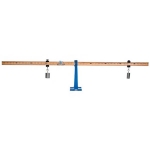
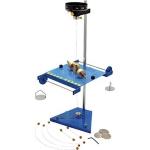
Organ Pipe Model Manufacturer,Supplier and Exporter in India
Product Code : SCL-MF-12506
The Organ Pipe Model is an educational physics apparatus used for demonstrating resonance, standing waves, harmonics, and sound production in an air column. It is intended for school physics laboratories, STEM classrooms, science teachers, students, colleges, and educational institutions seeking a practical teaching aid for introductory acoustics and wave phenomena.
Product Description
The Organ Pipe Model helps learners understand how a confined column of air can resonate at particular frequencies. During a supervised demonstration, students can relate pipe length and end conditions to resonant modes, pitch, wavelength, fundamental frequency, and harmonics.
This model is suitable for lessons on sound and wave physics and can complement other waves and sound laboratory apparatus. The exact construction material, pipe length, dimensions, weight, frequency range, end configuration, and operating method of this specific model have not been supplied; therefore, no unsupported specification is claimed.
Key Features
- Demonstrates resonance in air columns: Helps students observe how sound can be reinforced at natural resonant frequencies.
- Supports standing-wave lessons: Connects theoretical wave diagrams with practical acoustic demonstrations.
- Explains frequency and pitch: Helps relate the effective length of an air column to the frequency of the sound produced.
- Introduces harmonics: Supports teaching of the fundamental mode, overtones, and harmonic relationships where applicable.
- Suitable for comparative acoustics: Can be studied alongside a Resonance Tube for broader investigation of resonant air columns.
- Practical STEM learning: Useful for physics laboratories, science demonstrations, and teacher-led classroom activities.
- Transparent specifications: Unverified material, dimensions, frequency values, pipe configuration, and certifications are intentionally excluded.
Technical Specifications
|
Specification |
Detail |
|
Product Name |
Organ Pipe Model |
|
Brand |
School Equipments |
|
Product Category |
Physics Lab Apparatus / Waves and Sound / Acoustics Demonstration Model |
|
Primary Demonstration |
Resonance and standing waves in an air column |
|
Related Concepts |
Frequency, pitch, wavelength, fundamental mode, resonance, and harmonics |
What's Included in the Kit
- One Organ Pipe Model.
Any separate air source, blower, mouthpiece, stopper, tuning fork, measuring scale, instruction manual, or other accessory should be confirmed against the actual supplied configuration before publication or procurement.
Applications / Uses
- Demonstrating resonance in a column of air.
- Explaining standing waves and natural frequencies.
- Studying the relationship between air-column length and pitch.
- Introducing fundamental frequencies, overtones, and harmonics.
- Comparing organ-pipe principles with a Sound Pipe demonstration.
- Supporting school physics, acoustics, STEM, and science exhibition activities.
How to Use the Organ Pipe Model
- Place the model securely on a stable laboratory or classroom surface.
- Inspect the pipe and all supplied components before operation.
- Identify whether the supplied configuration is open, closed, adjustable, or otherwise designed for a specific demonstration.
- Generate sound or airflow only by the method specified for the actual model.
- Listen for or measure the resonant response produced by the air column.
- Where the design permits adjustment, compare different effective air-column lengths or end conditions.
- Relate the observations to wavelength, frequency, pitch, resonance, and standing-wave patterns.
Safety note: Use the apparatus under teacher or trained adult supervision. Do not apply excessive air pressure, modify the pipe openings, or use unapproved power or airflow sources.
Care & Maintenance
- Keep the pipe openings clean and free from dust or foreign objects.
- Handle the model carefully to avoid dents, deformation, or damage that could affect acoustic performance.
- Keep the apparatus dry and allow any moisture to disperse before storage.
- Store the model in a clean, protected location when not in use.
Why Choose School Equipments
School Equipments is a manufacturer and exporter of school laboratory equipment and educational science instruments. Its product range covers physics, chemistry, biology, mathematics, STEM education, and other practical laboratory applications for schools, colleges, universities, distributors, and institutional buyers. The company supports educational procurement and bulk equipment requirements. Buyers should confirm model-specific construction, dimensions, accessories, and performance details before final ordering.
Frequently Asked Questions
What is an Organ Pipe Model used for?
An Organ Pipe Model is used to demonstrate resonance, standing waves, frequency, pitch, and harmonics in an air column. It converts an abstract acoustics concept into an observable classroom experiment.
How does an organ pipe produce sound?
An organ pipe produces sound when its air column is excited and resonates at one or more natural frequencies. The resulting standing-wave pattern depends on factors including the effective pipe length and boundary conditions.
What is the difference between an open and closed organ pipe?
In the idealized physics model, a pipe open at both ends has a fundamental wavelength approximately twice its effective length. A pipe closed at one end has a fundamental wavelength approximately four times its effective length.
Can the Organ Pipe Model demonstrate harmonics?
Organ-pipe theory includes fundamental frequencies and higher resonant modes. Whether this specific model practically demonstrates multiple harmonics depends on its actual construction and operating configuration.
Is the Organ Pipe Model suitable for school laboratories?
Yes. It is suitable for supervised physics and STEM demonstrations involving sound waves, resonance, frequency, wavelength, and acoustics.
Can it be used with a tuning fork?
A tuning fork can be used to excite resonant air columns in suitable experimental arrangements, but compatibility with this particular Organ Pipe Model should be confirmed from the actual supplied configuration. Related demonstrations can also use a Tuning Fork with Resonance Box.
Explore the complete School Equipments waves and sound apparatus range for related resonance, vibration, frequency, acoustics, and standing-wave experiments.