Ultrasonics Kit
Product Code : EL-W-11194
Quick Answer: The Ultrasonics Kit demonstrates the wave nature of sound at 40 kHz, using a transmitter, receiver, slave transducer, two reflectors and a perforated plate to investigate reflection, interference and diffraction.
Last updated: October 2026
Key Features
- Operates at 40 kHz, giving a wavelength in air of approximately 8.3 mm
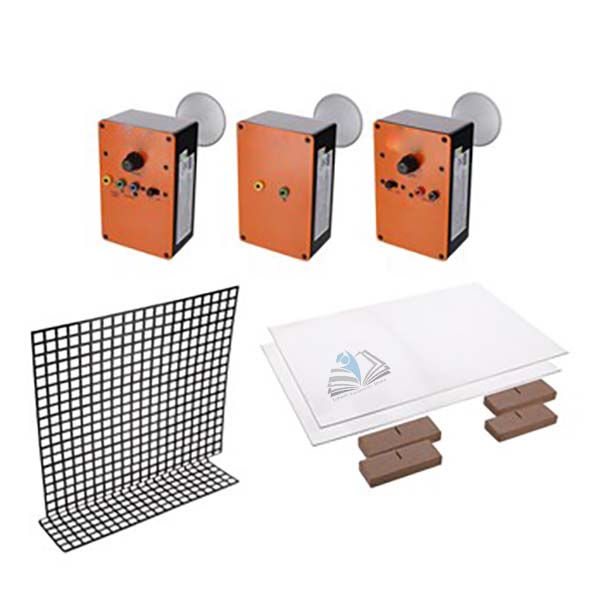
- Transmitter, receiver, slave transducer, two reflectors and a perforated plate
- Detachable exponential horns increase range and efficiency and form a narrow directional beam
- Transmitter and receiver supplied with equipment notes
- Pulse modulating the transmitter output allows a working sonar system to be assembled
- Speech can be transmitted over a 100 m distance
Technical Specifications
| Specification | Value |
|---|---|
| Operating frequency | 40 kHz |
| Wavelength in air | Approximately 8.3 mm, normal atmospheric conditions |
| Horns | Detachable exponential |
| Components | Transmitter, receiver, slave transducer, two reflectors, perforated plate |
About This Product
Ultrasound acts as a direct analogue of the properties of electromagnetic waves, so reflection, interference and diffraction of sound can be shown with this kit. The horns constrain the ultrasonic energy into the narrow beam that certain experiments need. The longitudinal, unpolarised nature of the vibrations means polarisation experiments cannot be performed as optical analogues. Individual units in the range are listed separately.
Frequently Asked Questions
Q1. Can polarisation be demonstrated with the Ultrasonics Kit?
No. The longitudinal, unpolarised nature of the ultrasonic vibrations does not allow polarisation experiments to be performed as optical analogues.
Q2. What wavelength does the kit produce?
At its operating frequency of 40 kHz, the wavelength in air is approximately 8.3 mm under normal atmospheric conditions.
Related: Waves, Wave Apparatus Demo.
For a quotation on the Ultrasonics Kit, contact School Equipments India.


.jpeg)