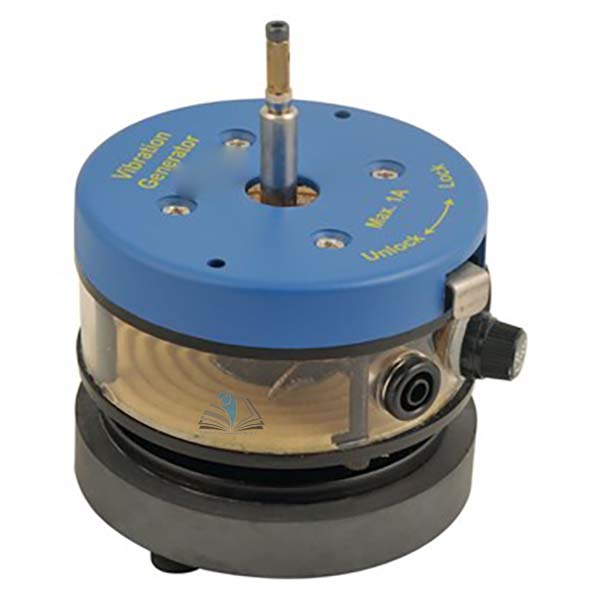
Quick Answer: The Vibration Generator produces mechanical oscillations from the signals of an oscillator/A.F. amplifier, such as a Power Signal Generator, over a total frequency range of D.C. to 10 kHz.
Last updated: October 2026
Key Features
Electrical input via two 4 mm sockets
Output shaft terminating in a pair of clamping nuts
Locking slider fixes the generator arm to prevent damage
Can be used in any position, free standing or clamped
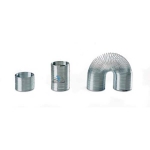
Demonstrates transverse and longitudinal waves
Technical Specifications
Specification
Value
Total frequency range
D.C. to 10kHz
Coil impedance
3.5 ohms at 50Hz
Maximum peak to peak displacement
8mm at 1Hz, decreasing with increase in frequency
Dimensions
(W)100mm x (D)90mm x (H)95mm
About This Product
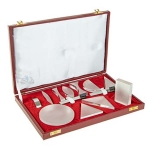
The generator turns electrical signals into mechanical oscillations at its output shaft. A Vibration Generator Accessory Kit, available separately or as part of a Vibration Generator Kit, adds accessories for demonstrating transverse, longitudinal, standing and 2-dimensional waves.
Frequently Asked Questions
Q1. What is needed to drive the generator? A Power Signal Generator, two 4 mm leads and a length of string. A Bench Signal Generator and Power Amplifier can be used in place of the Power Signal Generator.
Q2. How does displacement change with frequency? Maximum peak to peak displacement is 8 mm at 1 Hz and decreases as frequency increases.

 (1).png)



.jpg)