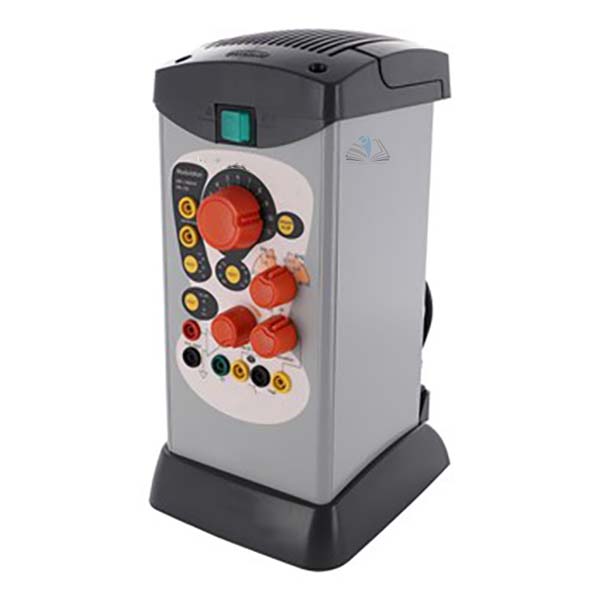
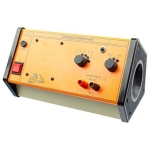
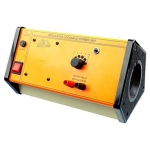
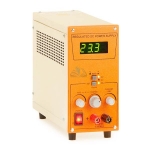
Quick Answer: The Power Signal Generator produces sine, square, triangular and TTL signals from 0.1Hz to 110kHz at up to 5W, for sound experiments, loudspeakers and a vibration generator.
Last updated: October 2026
Key Features
0.1Hz to 110kHz in 6 decades
Output power up to 5W, low and high impedance outputs
Built-in switchable speaker for the audible range
Amplitude and frequency modulation from an external signal
Auxiliary input to amplify a microphone or music player
High impedance output attenuates by 10 or 100
Technical Specifications
Specification
Value
Frequency range
0.1Hz - 110kHz in 6 decades
Output
Sine, square, triangular and TTL waveforms
Amplitude
0V to 5V
Fuse
T250mA time delay
Internal fuse
T2A time delay
Ratings
230V ac 50Hz 100VA
Temperature limits
10 - 40°C
About This Product
Frequency is set with a six-position decade dial and a large continuous dial giving a multiplier from x1 to x11. With the internal speaker switched on, the generator can show the range of human hearing, from 20Hz up to 20kHz. Its power output drives large speakers and the vibration generator for work on vibrations and waves, and the modulation inputs let students explore a.m. and f.m. radio signals. Export supply of the Power Signal Generator can be arranged to laboratories and schools in Guinea-Bissau, Antigua and Barbuda, Lesotho, Turkey and Grenada.
Frequently Asked Questions
Q1. Can it amplify an external signal? Yes. The auxiliary input lets the instrument amplify an external signal, such as from a microphone or music player, in place of the internal function generator.