
Coupled Pendulum Model
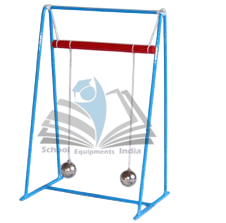
Product Code : SCL-EE-12144
The Coupled Pendulum Model by School Equipments India is an educational physics demonstration model designed to explain coupled oscillations, energy transfer, resonance, periodic motion, and simple harmonic motion. It is widely used in school physics laboratories, science classrooms, STEM labs, and science exhibitions to help students understand how two pendulums can influence each other when connected through a common support or coupling arrangement.
This model provides a practical and visual way to demonstrate how energy moves from one pendulum to another. When one pendulum is set into motion, the second pendulum gradually starts oscillating due to coupling. Over time, students can observe the transfer of energy between the two pendulums, making the concept of coupled motion easy to understand.
The Coupled Pendulum Model is a useful teaching aid for demonstrating oscillatory motion and energy exchange between connected systems. The model generally consists of two pendulum bobs suspended from a common support, thread or string arrangement, coupling medium, support stand, and base frame. When one pendulum is displaced and released, it begins to oscillate and transfers energy to the second pendulum through the coupling arrangement.
As the first pendulum loses energy, the second pendulum gains energy and starts swinging with greater amplitude. After some time, the energy transfers back to the first pendulum. This repeated transfer helps students understand coupled oscillation, resonance behavior, phase difference, amplitude variation, and energy conservation in mechanical systems.
The School Equipments India Coupled Pendulum Model is suitable for classroom demonstrations, physics practical sessions, STEM experiments, and science fair projects. It helps students connect theoretical wave and oscillation concepts with direct observation.
The Coupled Pendulum Model is an important physics teaching aid because it allows students to observe energy transfer between two oscillating systems. Instead of only studying formulas and diagrams, students can directly see how one pendulum affects the motion of another through coupling.
Teachers can use this model to explain simple harmonic motion, resonance, coupled oscillation, amplitude variation, phase relationship, energy conservation, and periodic motion. It also helps students understand real-life systems such as coupled mechanical structures, vibrations in bridges, musical instruments, and energy transfer in wave systems.
The Coupled Pendulum Model is a reliable physics lab model for schools looking for practical oscillation and resonance demonstration equipment. It helps students understand coupled oscillations, energy transfer, simple harmonic motion, amplitude change, phase difference, frequency, and resonance through hands-on observation. This model is suitable for science teachers, school laboratories, STEM programs, educational institutions, and science fair demonstrations.
School Equipments India supplies educational science models, physics laboratory apparatus, mechanics demonstration models, STEM kits, geography models, and classroom teaching aids for schools and institutions. The Coupled Pendulum Model is designed for practical classroom use and supports clear explanation of oscillation, resonance, and energy transfer concepts.
This product content supports Google E-E-A-T guidelines by providing clear product information, accurate educational purpose, practical usage instructions, product specifications, safety guidance, and classroom applications. The content is written for science teachers, school buyers, laboratory planners, STEM educators, and educational institutions looking for dependable physics demonstration models.
Coupled Pendulum Model, coupled pendulum apparatus, pendulum oscillation model, resonance demonstration model, physics lab pendulum model, simple harmonic motion apparatus, energy transfer pendulum model, oscillation demonstration apparatus, STEM physics teaching aid, School Equipments India Coupled Pendulum Model.
A Coupled Pendulum Model is a physics demonstration model used to show how two pendulums connected through a coupling arrangement transfer energy between each other during oscillation.
It is used to teach students about coupled oscillations, energy transfer, resonance, simple harmonic motion, amplitude variation, and periodic motion.
It demonstrates the principle of energy transfer between coupled oscillating systems. When one pendulum oscillates, energy is gradually transferred to the second pendulum through coupling.
No, the Coupled Pendulum Model is a manual physics demonstration model and does not require electricity for basic experiments.
When one pendulum is set into motion, it gradually transfers energy to the second pendulum. The first pendulum slows down while the second pendulum starts oscillating with greater amplitude.
Yes, it is suitable for school physics laboratories, science classrooms, STEM labs, colleges, and practical demonstrations.
Yes, students can perform demonstrations under teacher supervision. The model is designed for hands-on observation and practical learning.
Teachers can explain coupled oscillation, resonance, simple harmonic motion, amplitude, frequency, phase difference, energy conservation, and periodic motion.
Yes, the Coupled Pendulum Model is useful for science exhibitions because it provides a clear and visual demonstration of energy transfer and oscillatory motion.
This Coupled Pendulum Model is supplied by School Equipments India.
Coupled Pendulum Model for School Physics Laboratory
Product Description
Key Features
Product Specifications
Product Name
Coupled Pendulum Model
Brand
School Equipments India
Category
Physics Lab Model / Oscillation Demonstration Model / STEM Teaching Aid
Application
Demonstration of coupled oscillations, resonance, energy transfer, and periodic motion
Working Principle
Energy transfer occurs between two oscillating pendulums through coupling
Main Components
Support frame, two pendulum bobs, suspension strings, coupling arrangement, base stand, and demonstration accessories as per supplied model
Suitable For
Schools, colleges, physics laboratories, science classrooms, STEM labs, and science exhibitions
Usage Type
Manual physics demonstration and practical model
Learning Topics
Coupled oscillation, simple harmonic motion, resonance, energy transfer, amplitude, phase difference, frequency, and periodic motion
Power Requirement
No electricity required
Material
Durable educational-grade components; specifications may vary as per supplied model
Packaging
Securely packed for safe transportation and institutional supply
How to Use the Coupled Pendulum Model
Safety and Handling Instructions
Educational Importance
Applications
SEO-Friendly Product Benefits
Why Choose School Equipments India?
E-E-A-T Content Note
SEO Keywords
Frequently Asked Questions
1. What is a Coupled Pendulum Model?
2. What is the use of this model in schools?
3. Which principle does the Coupled Pendulum Model demonstrate?
4. Does this model require electricity?
5. What happens when one pendulum is set into motion?
6. Is this model suitable for school physics laboratories?
7. Can students perform experiments using this model?
8. What topics can teachers explain using this model?
9. Is the Coupled Pendulum Model useful for science exhibitions?
10. Which brand supplies this Coupled Pendulum Model?




-Photoroom (1).png)
.jpg)