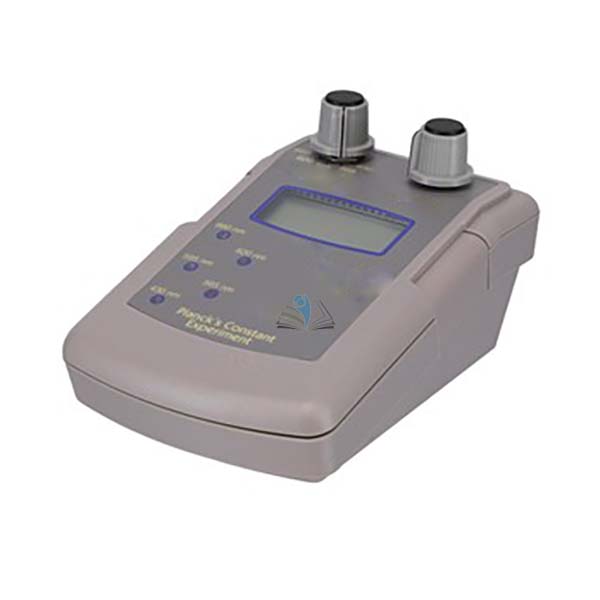
Quick Answer: Plancks Constant Experiment is a complete, self-contained, battery-powered unit for establishing Planck's constant using 5 LEDs of wavelengths 430, 565, 595, 620 and 660 nm and a built-in digital voltmeter.
Last updated: October 2026
Key Features
5 LEDs: 430, 565, 595, 620 and 660 nm
Rotary switch selects 1 LED, viewable through holes in the sloping front panel
Potentiometer raises the LED voltage until the LED just begins to glow
Built-in digital voltmeter shows the voltage across the LED
LED wavelengths indicated on the case
Requires a PP3 battery
Technical Specifications
Specification
Value
LED wavelengths
430, 565, 595, 620, 660 nm
Number of LEDs
5
Power
PP3 battery
Display
Built-in digital voltmeter
About This Product
At the photon threshold, shown by the selected LED just beginning to glow, the voltage reading gives the electron energy and hence the photon energy. Knowing that energy and the LED's characteristic wavelength, Planck's constant can be determined. The method assumes that at threshold all energy released in recombination becomes photon energy. The Plancks Constant Experiment is available for supply within India and for export to Uruguay, Malawi, Peru, New Zealand, Armenia and South Sudan.
Frequently Asked Questions
Q1. How is the threshold voltage found? Turn the potentiometer to raise the voltage across the selected LED until it just begins to glow, then read the voltage on the built-in digital voltmeter.

 (1).png)


 (1).png)