
Speed of Light
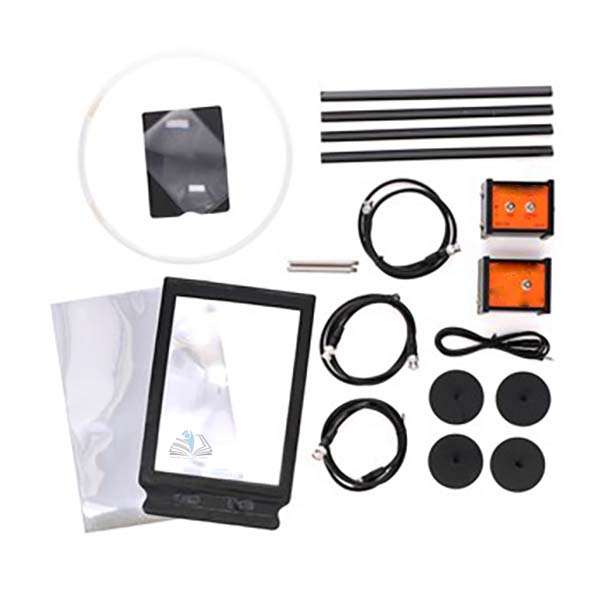
Product Code : EL-W-11172
Quick Answer: The Speed of Light kit measures 'c' directly within a science laboratory by timing light pulses from an LED pulsed at 1 MHz over a return journey of typically 30 m.
Last updated: October 2026
Key Features
- Transmitter with a high intensity LED pulsed at 1 MHz, and a matching receiver
- Transmitter supplies a synchronisation pulse to the oscilloscope
- Mirror, 2 rods for mounting and two Fresnel lenses with holders
- Connecting leads included, with a fibre optic cable
- Plug-top power supply and full instruction booklet
- Supplied in a tray
Technical Specifications
| Specification | Value |
|---|---|
| Transmitter LED | High intensity, pulsed at 1 MHz |
| Aligned run distance | 1 metre |
| Typical return path | 30 m across the laboratory |
| Typical return time | 0.1 µs |
| Oscilloscope required | Double-beam with external trigger, bandwidth at least 20 MHz, time-base resolution 20 ns per division |
About This Product
The experiment is run twice: first with the transmitter and receiver aligned 1 metre apart, then with the pulses sent across the laboratory to the mirror and reflected back. The oscilloscope shows the transmitted pulse as Y1 and the received signal as Y2, and the shift in the Y2 trace between the two runs gives the time from which the speed of light is calculated. Comparing 'c' in air with its value in the plastic of the fibre optic cable gives the refractive index directly.
Frequently Asked Questions
Q1. What oscilloscope is needed for the Speed of Light kit?
A double-beam oscilloscope with an external trigger, a bandwidth of at least 20 MHz and a time-base resolution of 20 ns per division.
Q2. Can the kit be used to find refractive index?
Yes. Comparing the speed of light in air with that in the plastic of the fibre optic cable allows the refractive index to be calculated directly.
Related: Waves, Modulated Laser Receiver Unit, LED modulator.
For a quotation on the Speed of Light, contact School Equipments India.


 (1).png)


.png)

